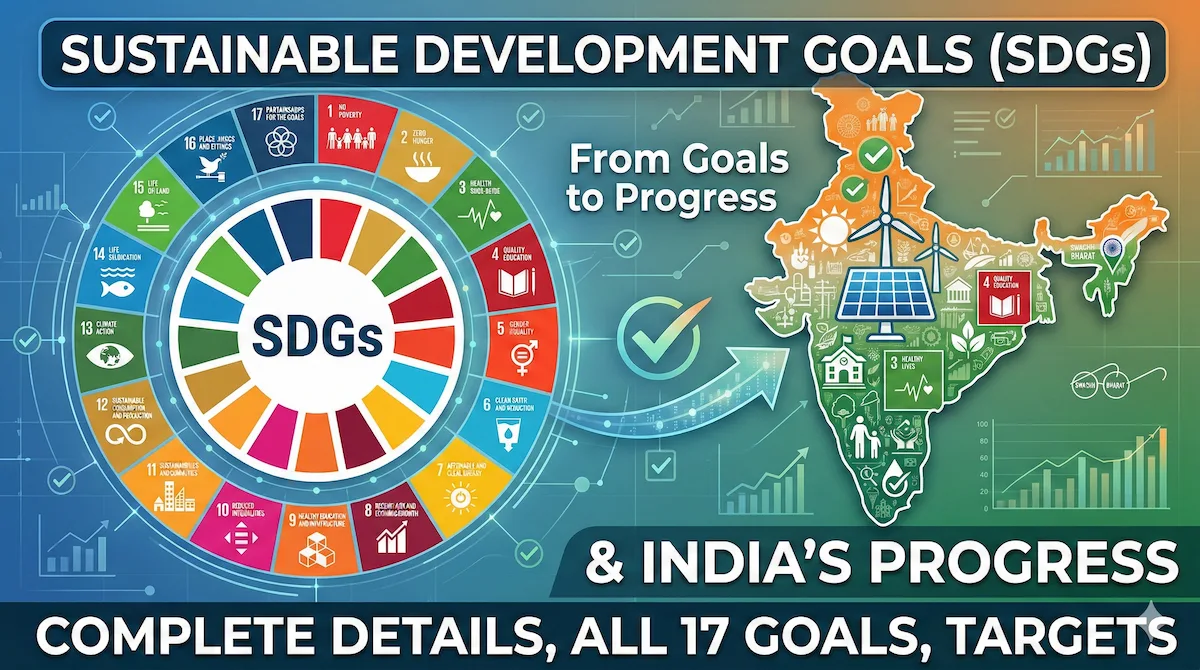
If you are preparing for UPSC, SSC, Banking exams, or any State PSC, mastering Sustainable Development Goals (SDGs) is not optional — it is essential. SDGs are among the most frequently asked topics in General Studies, Current Affairs, and Essay papers. This comprehensive guide covers everything you need to know: history, all 17 goals, 169 targets, India's progress, and exam strategy.
What Are Sustainable Development Goals (SDGs)?

Photo: Unsplash (Free to use)
Sustainable Development Goals are a universal blueprint adopted by the United Nations to achieve a better and more sustainable future for all. These 17 goals address the root causes of global challenges — from poverty and hunger to climate change, inequality, and access to clean water.
The SDGs are not just for developing nations. Every country, including India, is accountable for their achievement. They are interconnected — progress in one goal directly impacts others. For example, achieving Gender Equality (Goal 5) accelerates progress in education (Goal 4), health (Goal 3), and economic growth (Goal 8).
History and Background of SDGs

Photo: Pexels (Free to use)
The journey to SDGs began at the Rio+20 United Nations Conference on Sustainable Development held in Rio de Janeiro in 2012. World leaders agreed to develop a set of global goals to succeed the Millennium Development Goals (MDGs), which ran from 2000 to 2015.
After three years of extensive global consultations involving governments, civil society, businesses, and citizens, the 2030 Agenda for Sustainable Development was unanimously adopted by all 193 UN Member States on 25 September 2015. The goals came into official effect on 1 January 2016.
MDGs (2000–2015) focused primarily on developing nations. SDGs (2016–2030) are universal — applicable to every nation, including wealthy countries. SDGs also cover 17 goals vs MDGs' 8 goals, with a far broader scope including climate, inequality, and institutions.
All 17 Sustainable Development Goals – Complete List

Photo: Pexels (Free to use)
No Poverty
Zero Hunger
Good Health and Well-being
Quality Education
Gender Equality
Clean Water and Sanitation
Affordable and Clean Energy
Decent Work and Economic Growth
Industry, Innovation and Infrastructure
Reduced Inequalities
Sustainable Cities and Communities
Responsible Consumption and Production
Climate Action
Life Below Water
Life on Land
Peace, Justice and Strong Institutions
Partnerships for the Goals
Importance of SDGs for India

Photo: Unsplash (Free to use)
India's SDG journey is among the most significant in the world. As the world's most populous nation with 1.4 billion people, India's success or failure on SDGs directly shapes global averages.
- NITI Aayog is the nodal agency for SDG implementation and monitoring in India.
- The SDG India Index (published annually by NITI Aayog) ranks all states and UTs on their SDG performance.
- India has shown impressive gains in Goal 7 (Clean Energy) with massive solar expansion.
- Schemes like PM Garib Kalyan Anna Yojana, Jal Jeevan Mission, PM Awas Yojana directly align with SDG targets.
- India's Voluntary National Review (VNR) has been presented at the UN High-Level Political Forum.
SDGs and Competitive Exams – What to Study
SDGs appear consistently in UPSC Prelims, Mains GS Paper II & III, SSC CGL, IBPS PO, and State PSC exams. Here's exactly what exam aspirants must focus on:
- ✅ All 17 goals with their goal numbers and names (frequently asked in MCQs)
- ✅ Year of adoption (2015) and implementation date (2016)
- ✅ Difference between SDGs and MDGs
- ✅ India's SDG India Index scores and top/bottom performing states
- ✅ Which Indian government schemes align with which SDG goal
- ✅ Goal 13 (Climate Action) linkage with Paris Agreement, COP summits
- ✅ Goal 17 (Partnerships) — India's role in South-South cooperation